
SAG MILL FILLER RING
Filler Ring
Transition ring segments between shell and head liners · Distinct from shaft seals and sealing packing
Fills the annular transition in the lining system to maintain a continuous protective surface. ANRANST provides position identification, material assessment, drawing review, quality control and finished-part delivery.
Part Function Circumferential position Position numbers, segment count, segment identifiers and assembly sequence Section profile Inner and outer radii, arc length and height, width, thickness and transition surfaces Adjacent Interfaces Shell liners, head liners, joints, steps and shell seating surfaces Fastening system Hole positions, counterbores, bolts, washers, seating surfaces and rear contact
Fill the annular transition and maintain a continuous liner surface
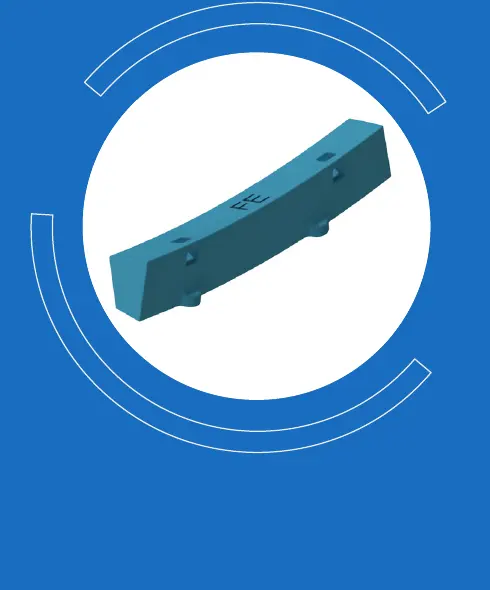
A filler ring generally comprises several curved segments at the transition between shell and head liners. It protects the shell, controls gaps and reduces direct exposure of steps and joints.
For replacement, check the inner and outer radii, arc length and height, section profile, position number, segment count, hole pattern and height differences between adjoining liners.
Interface performance
Check working surfaces, joints, edges and areas around holes separately
Filler ring performance depends on continuity and correct positioning around the complete transition ring, as well as individual segment hardness.
Working surface
Check abrasive wear, local impact, remaining thickness and height differences between adjoining liners.
Segment joints
Check joint opening, trapped material, chipped edges, slurry erosion and assembly sequence.
Transition edges
Check steps, profiles and local stress concentrations at the shell-to-head liner interfaces.
Hole areas and rear surface
Check preload, seating surfaces, cracks around holes, rear erosion and contact.
Materials and Manufacturing Processes
Coordinate material selection with adjoining liners, impact levels and support conditions
Specify the final material, hardness, heat treatment and acceptance criteria according to the approved drawing, installed position and operating conditions.
Assess filler ring wear around the full circumference together with adjoining shell and head liners. Metso Mill Liners
Failure Diagnosis
Address open joints, chipped edges, uneven wear and looseness separately
Record failures by segment position so that local problems are not obscured by averages for the whole ring.
| Observed condition | Priority checks | Improvement Options |
|---|---|---|
| Open segment joints or trapped material | Segment count, arc length, cumulative gap, assembly sequence and temperature condition | Restore the dimensional fit and positioning of the complete ring |
| Chipped edges or broken segments | Steps between adjoining parts, impact, radii, hardness, support and casting defects | Improve transitions and toughness, and strengthen nondestructive inspection |
| Localized uneven wear | Working-surface height differences, material trajectory, position, material and adjoining liner wear | Adjust thickness, profile and material for each position |
| Cracks or looseness around holes | Hole positions, counterbores, grip length, washers, seating surfaces and rear contact | Restore the complete fastening system and installation procedure |
Drawings and Inquiry Details
Identify the filler ring by transition ring position and segment number
Match drawing and spare model details to the equipment, installation position and drawing revision.
Equipment identification
OEM, series, full model, serial number, head configuration and modification history.
Position and Identification
Position numbers, segment identifiers, quantity per complete ring, OEM drawing, samples and spare model details.
Key dimensions
Inner and outer radii, arc length and height, width, thickness, cross-section and hole spacing.
Adjacent Interfaces
Shell liners, head liners, joints, steps, seating surfaces and fasteners.
Material and Service Life
Current material, hardness, heat treatment, installation date, service life and remaining thickness.
Operating Conditions and Failure Modes
Ore, particle size, grinding media, throughput, impact, uneven wear, chipping and photographs.
Related Equipment and Parts
Match the transition ring to the lining system and OEM mill configuration
Filler rings with the same name are not necessarily interchangeable. Confirm the full mill model and drawings.
Shell Lifter Plate Check the adjoining shell-side working surfaces. Feed-End Outer Liner Check the adjoining head-side profiles. Intermediate Discharge Liner Check the adjoining discharge-end transition parts. SAG Lining and Discharge System Return to the complete system and inquiry requirements. Metso SAG Mill Equipment Identify the installed machine by brand, series, model and drawing.