
SAG MILL THROAT LINER
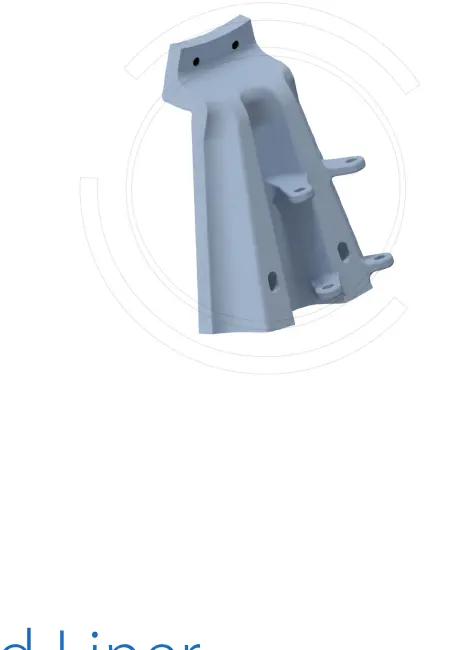
Feed Throat Liner
Replaceable feed-end wear part · Supplied to drawing, interfaces and operating requirements
Installed in the SAG mill feed throat to protect the underlying structure from ore and guide material into the mill. ANRANST provides mill identification, material assessment, drawing review, quality control and finished-part delivery.
Part Function Internal and external profiles Passage cross-section, tapered surfaces, curvature and minimum clearance Mounting Interfaces Flange, hole positions, counterbores, fasteners and adjoining liners Orientation markings Feed direction, rotation direction, top/bottom orientation and assembly datums Delivery scope Individual parts, matching fasteners, identification and inspection documents
Protect the feed end and maintain a continuous inlet passage
The throat liner sits between the feeder, trunnion or inner feed-end liners. Its internal and external profiles, axial length, flange and hole positions determine correct seating, fastening and a continuous passage to adjoining liners.
Parts with the same name are not necessarily interchangeable. Even mills of the same diameter may use different drawing because of differences in OEM, shell length, feed-end version, rotation direction or modifications.
Position and Performance
Address impact fracture at the feed end before optimizing wear life
Assess component design, rear support, fastening and material as a single system.
Feed impact zone
Check large ore impacts, locally thin sections, casting radii and cracks around holes. Adequate core toughness and continuous support are essential.
Passage wear zone
Check sliding abrasion, slurry erosion, uneven flow and profile changes. An effective passage and safe remaining thickness must be maintained as wear progresses.
Attachment and sealing zone
Check contact surfaces, bolt preload, slurry leakage around holes, steps between adjoining parts and looseness. Inspect the fastening system when replacing the working surface.
Materials and Manufacturing Processes
Screen material candidates for impact, abrasion and support conditions
Specify the final grade, chemical composition, hardness and heat treatment in the approved drawing and technical agreement.
Metso mill lining literature treats the feed end, shell, discharge and trunnion as distinct functional areas, with metal, rubber and composite lining systems. Confirm each replacement against the installed drawings and site conditions. Metso Mill Liners
Failure Diagnosis
Use cracks, uneven wear and looseness to assess materials and interfaces
Photographs of used parts and wear measurements provide more useful information than a material name alone.
| Observed condition | Priority checks | Improvement Options |
|---|---|---|
| Cracking around holes, at rib roots or in thin sections | Large-particle impact, radii, abrupt section changes, hardness, casting defects, rear contact and preload | Improve fracture resistance, transitions, support, heat treatment and nondestructive inspection |
| Localized uneven wear on the feed side | Uneven feed flow, impact point, rotation direction, passage profile, steps between adjoining parts and worn clearances | Adapt profiles and materials to the impact and flow conditions in each zone, and restore a continuous passage |
| Loose bolts or slurry leakage | Grip length, seating surfaces, washers, seals, lubrication, preloading method and contact | Restore the complete fastening and sealing system, and record installation torque or bolt elongation |
| Rapid working-surface wear without fracture | Ore abrasiveness, flow velocity, liner thickness, current material, hardness gradient and target service life | Improve profile retention and wear resistance while maintaining the required toughness |
Drawings and Inquiry Details
Identify the installed mill before specifying the individual part
Match confirmed OEM drawing, third-party drawing and spare model details to the installed model and drawing revision.
Equipment identification
OEM, series, full model, serial number, year of manufacture, feed-end version and modification history.
Part references and drawings
OEM drawing, third-party drawing, spare model details, drawing revisions, assembly drawings and adjoining part references.
Key dimensions
Internal and external profiles, axial length, flange, hole positions and diameters, liner thickness, interfaces, weight and orientation.
Material information
Current material, chemical composition, hardness, heat treatment, composite construction, inspection results and samples from used parts.
Operating conditions and service life
Ore, feed size, abrasiveness, slurry, steel balls, throughput, installation date and actual service life.
Failure records
Overall and close-up photographs, crack locations, wear measurements, looseness, slurry leakage and the reason for replacement.
Related Equipment and Parts
Connect equipment, OEM configuration, lining system and material selection
Use this page to bring together part identification, material requirements and RFQ details from any of these routes.
SAG Mill Lining Systems Return to the complete feed-end, shell, discharge and drive system. General SAG Mills Information Explore the equipment structure, operating principles and component locations. Metso SAG Mill Equipment Identify the installed equipment by brand, series, model and drawing. Wear-Resistant Alloy Steel Review impact, abrasion, heat treatment and quality control requirements.