Air classifier

Air classifier · 1986-03-03 · 4 models

Hardinge Air classifier – Air classifier
Hardinge Air classifier – Air classifier (2)
Hardinge
HardingeBrand
Air classifierEquipment type
1986-03-03Period
Historical modelStatus
Hardinge

Models and Historical Names in This Series

Select a model to jump to its component table; former and renamed designations are listed under “Historical names / renamings”.

ModelHistorical names / renamingsPeriodComponents
Hardinge Double Cone air classifier (name candidate)Hardinge Double Cone1986-03-038
Hardinge Loop Classifier air classifierHardinge Loop Classifier; Hardinge loop classifier; Hardinge Loop classifierEPA19781
Hardinge Rotary air classifier (1925 named configuration)Hardinge rotary air classifier; rotary classifier1925-02-214
Hardinge Superfine Classifier air classifierHardinge Superfine Classifier; Hardinge Superfine classifier; Hardinge rotary-and-superfine classifierEPA197810
Hardinge

Numbered Components

The numbers on the diagram correspond one to one with the rows below.

No.ComponentLocationApplies to
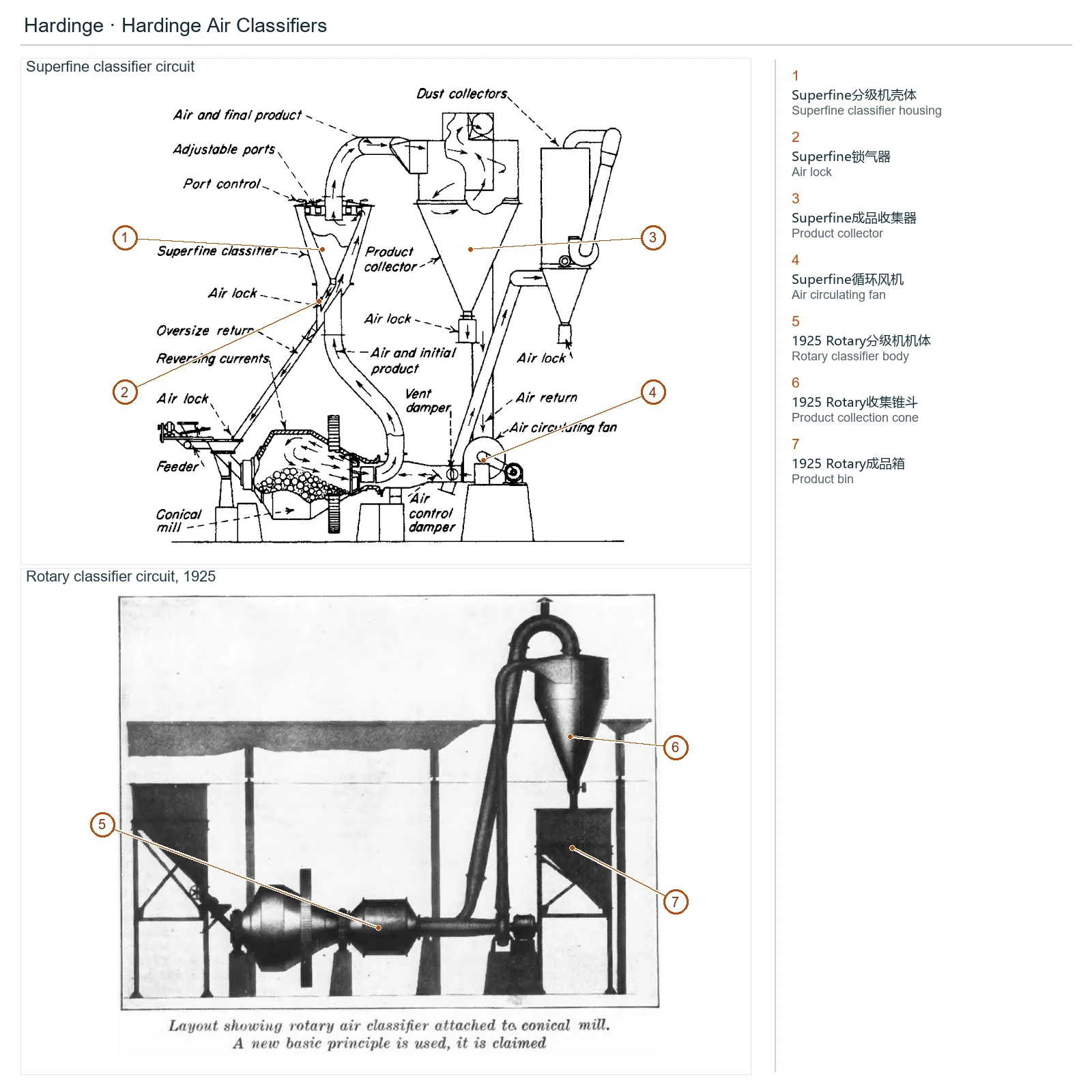
1Superfine classifier housingVisible superfine classifier housing in Superfine classifier circuitSuperfine;1997 Fig20-42
2Air lockVisible air lock in Superfine classifier circuitSuperfine;1997 Fig20-42
3Product collectorVisible product collector in Superfine classifier circuitSuperfine;1997 Fig20-42
4Air circulating fanVisible air circulating fan in Superfine classifier circuitSuperfine;1997 Fig20-42
5Rotary classifier bodyVisible rotary classifier body in Rotary classifier circuit, 19251925 Rotary
6Product collection coneVisible product collection cone in Rotary classifier circuit, 19251925 Rotary
7Product binVisible product bin in Rotary classifier circuit, 19251925 Rotary
Hardinge

Components by Model

Models with the same components are grouped together; select a group to open its component table.

Hardinge Superfine Classifier air classifier10 items
No.ComponentLocation
1Superfine conical grader housingSuperfine classifier outline on the upper left in the figure; illustrative shell name
2Superfine air lockAir lock at the bottom of the grader; other air locks are in the external collection system
3Superfine system finished product collectorThe product collector external to the grader does not belong to the internal BOM of the main body.
4Superfine system circulation fanAir circulating fan at the bottom of the external return duct
Superfine adjustable air holesAnnular air holes on the top of the grader in the picture, Adjustable ports
Superfine air hole control mechanismTop of grader, Port control; detailed component form not included
Superfine coarse material return pipeOversize return line from classifier to mill; do not treat air flow as an independent part
Superfine system dust collectorThe dust collectors outside the original image do not belong to the internal BOM of the main body.
Superfine system ventilation control valveVent damper in front of circulation fan
Superfine system air regulating valveAir control damper for mill outlet circulation line
Hardinge Double Cone air classifier (name candidate)8 items
ComponentLocation
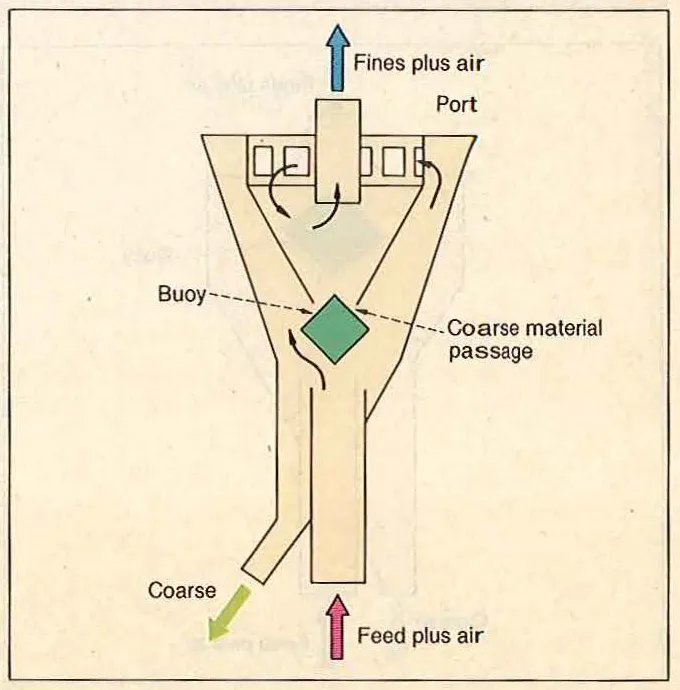
Author's concept inner coneThe adjustable air holes on the upper part of the inner cone allow the air to rotate and coarse particles to fall.
Author's concept of outer cone housingFigure 8 biconical outer layer; actual manufacturing connection/thickness unknown
Author’s concept of adjustable peripheral air holesThe upper part of the inner cone, the original table lists Ports and notes that it is adjustable
Author's concept of coarse material air lock floating plugFigure 8 Buoy; the text clearly states the rough material air lock, and does not misname the rotor or original parts.
Author’s concept of coarse material discharge channelFigure 8 side lower channel, no valve or material is given
Author's concept of fine materials and air outlet
External fan listed by the authorOut in PDF3 table, peripheral system supporting instead of built-in/Hardinge self-made proof
External fines collector listed by the authorOut in the PDF3 table, the specific type and manufacturer are not included
Hardinge Rotary air classifier (1925 named configuration)4 items
No.ComponentLocation
51925 Rotary grader bodyCentral grader shown connected to cone mill; internal parts not shown
61925 Rotary system finished product collection coneThe cone-shaped container on the upper right of the original assembly diagram; the finished product is sent to the product bin; external matching
71925 Rotary system finished product boxProduct bin at the lower right of the original assembly diagram; external matching, internal discharge valve is not inferred
1925 Rotary system loop pipeThe pipeline between the original combination diagram grader, upper collector and loop; external accessories
Hardinge Loop Classifier air classifier1 item
ComponentLocation
External fine particle collection device (optional)Basic recommends fine powder outlet in the process; choose one of cyclone collector or bag filter

Frequently asked questions

Which models does the Air classifier cover?

The Air classifier covers 4 models: Hardinge Double Cone air classifier, Hardinge Loop Classifier air classifier, Hardinge Rotary air classifier, Hardinge Superfine Classifier air classifier. Former and renamed designations are listed in the models table on this page.

What other names or designations is the Air classifier known by?

The Air classifier is also documented under these designations: Hardinge Double Cone air classifier, Hardinge Double Cone, Hardinge Loop Classifier air classifier, Hardinge Loop Classifier, Hardinge Rotary air classifier, rotary classifier, Hardinge Superfine Classifier air classifier, Hardinge Superfine Classifier, Hardinge rotary-and-superfine classifier.

Which brand and type of equipment is the Air classifier?

The Air classifier is listed under the Hardinge brand as: Air classifier. Period: 1986-03-03. Status: Historical model.

Which components and wear parts are recorded for the Air classifier?

23 components are recorded, including: Author's concept inner cone, Author's concept of outer cone housing, Author’s concept of adjustable peripheral air holes, Author's concept of coarse material air lock floating plug, Author’s concept of coarse material discharge channel, Author's concept of fine materials and air outlet, External fan listed by the author, External fines collector listed by the author and more. The full list with locations is in the components table on this page.

How do I enquire about parts for the Air classifier?

Send us a drawing or sample and tell us the equipment model and part name.

Send us a drawing or sample and tell us the equipment model and part name

Provide the equipment model, drawing for engineering review and quotation. If service life or wear is a concern, describe the operating conditions as well.

Equipment Brand and ModelDrawingDrawing or DimensionsCurrent MaterialPhotographs of Failed PartsTarget Service LifeOperating Conditions
Request a Quote

Or contact us directly: +86 156 3797 3199
zzx@anranst.com

Manufacturing Services in China

From Technical Assessment to Finished-Part Delivery

ANRANST provides customers worldwide with engineering assessment, production at certified foundries to the customer technical requirements, quality control and finished-part delivery for custom wear parts and industrial spares, with scope to support other custom industrial parts.

01

Drawing and Engineering Review

We review mating surfaces and interface dimensions and assess material, heat treatment and manufacturing feasibility.

02

Material and Heat-Treatment Specification

Material grades and heat-treatment processes are specified order by order, stated in the technical agreement and tracked through production.

03

Quality Control

Drawing confirmation, material and process control, production tracking, inspection and acceptance coordination.

04

Finished-Part Delivery

We coordinate manufacturing, quality confirmation, packaging and delivery of complete finished parts in a workable, closed-loop supply process.

Provide the existing model, drawings, drawing, materials or operating conditions so we can identify the appropriate technical review and supply route.

Submit an Enquiry