
HPGR SCRAPER / CLEANER
HPGR Scrapers and Cleaners
Cleaning devices near rolls or discharge · Identify by bracket, profile, angle and working clearance
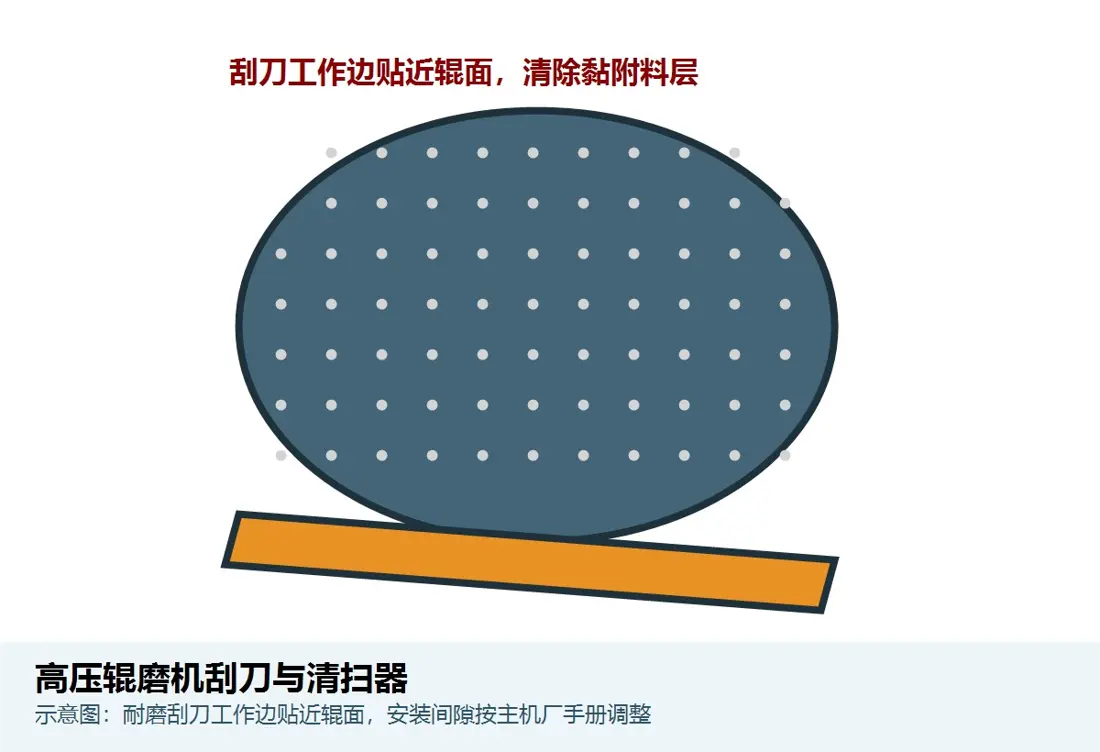
Some HPGR installations have scrapers or cleaners to control adhering material, buildup or residue near the rolls. ANRANST checks the actual roll, end, bracket, blade profile, angle, working clearance, flexible or rigid material, wear records and drawing for the installed design.
Assembly Function Position Identification Fixed/floating roll, drive/non-drive end and cleaning zone Geometry identification Blade length, cross-section, working edge, angle and clearance Material identification Elastomer, engineering plastic, metal or composite working edge Assembly identification Brackets, clamping plates, springs, adjusters and fasteners
Control adhering material and buildup without damaging the roll surface
Cleaning depends on blade profile, contact or non-contact operation, installation angle, preload, roll condition, feed moisture and speed. Excessive clearance can reduce cleaning effectiveness; insufficient clearance can cause abnormal friction, heating and roll damage.
Blades usually work with brackets, clamping plates, springs or adjusters. Check bracket deformation and adjustment mechanisms when replacing a blade strip to avoid recurring uneven wear.
Structure and Performance
Working edges, brackets, preload and roll condition jointly determine cleaning performance
Confirm the contact arrangement before specifying materials and working clearance.
Contact scraper blades
The working edge maintains controlled contact with the target surface. Check preload, friction, temperature rise, wear and compatibility with the roll surface.
Non-contact cleaners
Use controlled clearance to limit buildup. Check clearance across the width, roll runout, bracket stiffness and particle size.
Flexible working edges
Can accommodate some contour variation and runout. Assess abrasion, cutting, tearing, temperature, oil and moisture exposure.
Rigid or metal working edges
Where the design uses these edges, control profile, hardness difference, clearance and foreign-object risk to prevent roll damage.
Brackets and adjustment
Bracket straightness, angle, springs, stops and fasteners determine consistent contact or clearance across the width.
Left/right position management
Record wear and adjustment by roll and end to identify uneven flow, roll runout or bracket deformation.
Materials and Manufacturing Processes
Match working-edge material to the roll structure and contact arrangement
Confirm compound, hardness, cross-section and service-life targets using controlled drawings, samples and operating validation.
Selection sequence: material adhesion and roll condition → contact arrangement and loading → material and working edge → bracket and adjustment → clearance acceptance → cleaning and service-life records.
Failure Diagnosis
Use wear patterns across the width to identify material, clearance, bracket or roll problems
Check bracket straightness and actual roll operation before replacing the blade.
| Observed condition | Priority checks | Improvement Options |
|---|---|---|
| Excessive wear or heating across the width | Preload, contact pressure, material, speed, temperature, roll roughness and trapped feed | Reduce abnormal friction and reassess material and preload |
| One-sided or local uneven wear | Bracket straightness, installation angle, roll runout, blade deformation and left/right adjustment | Restore consistent geometry across the width before replacing the blade |
| Blade tearing, chipping or fracture | Trapped coarse particles, clearance, material toughness, edge geometry, support and foreign objects | Improve foreign-object passage and working-edge design |
| Reduced cleaning despite limited wear | Clearance, preload, buildup, feed moisture, roll profile and working-edge orientation | Restore adjustment and cleaning conditions first |
| Roll scoring or unusual polished bands | Rigid working edge, foreign objects, hardness difference, installation angle, contact pressure and roll runout | Inspect interference promptly to prevent further roll damage |
Drawings and Inquiry Details
Identify assemblies by installation position, bracket, working edge and adjustment conditions
Record confirmed drawing and customer model details together. Manufacture to the controlled drawing revision.
Equipment and location
OEM, full model, serial number, fixed/floating roll, drive/non-drive end and cleaning position.
Blade geometry
Length, width, thickness, cross-section, working-edge profile, orientation, angle and quantity.
Brackets and adjustment
Bracket outline, hole pattern, clamping plates, springs, stops, preload, adjustment range and working clearance.
Drawing or sample and materials
drawing, customer model details, revision, material, hardness and manufacturing process.
Roll surface and feed
Roll surface structure, diameter, runout, speed, particle size, moisture, adhesion and foreign objects.
Operation and Failure
Wear locations, adjustment records, cleaning performance, heating, vibration, abnormal noise and site photographs.
Related Equipment and Parts
Connect scrapers with roll surfaces, HPGR equipment, OEM installations and materials
This page covers general cleaner structures and failures. Use OEM equipment pages to confirm whether a cleaner is fitted and its installation position.
HPGR Roll Surfaces and Sleeves Check the roll surface structure, diameter and working layer beside the scraper. General High Pressure Grinding Rolls Information Review the relationship between the rolls, feed, discharge and cleaning positions. Metso HRC / HRCe Check whether the specific HRC / HRCe model has the relevant cleaning assembly. FLS HPGR Identify blade and bracket drawing through the FLS equipment series. thyssenkrupp Polysius HPGR Check cleaner structures through the brand's equipment series. Rubber and Polyurethane Review flexible blade selection for abrasion, cutting, temperature and environmental exposure.
ANRANST is an independent wear-parts engineering team. OEM names and trademarks belong to their respective owners. Before ordering, confirm that the equipment has this assembly and verify the full model, installation position, drawings, clearance and operating conditions.