
HPGR ROLL BEARING / BEARING SEAL
HPGR Roll Bearings and Bearing Seals
Heavy-load roll support and contamination control · Identify by full designation, end position and fits
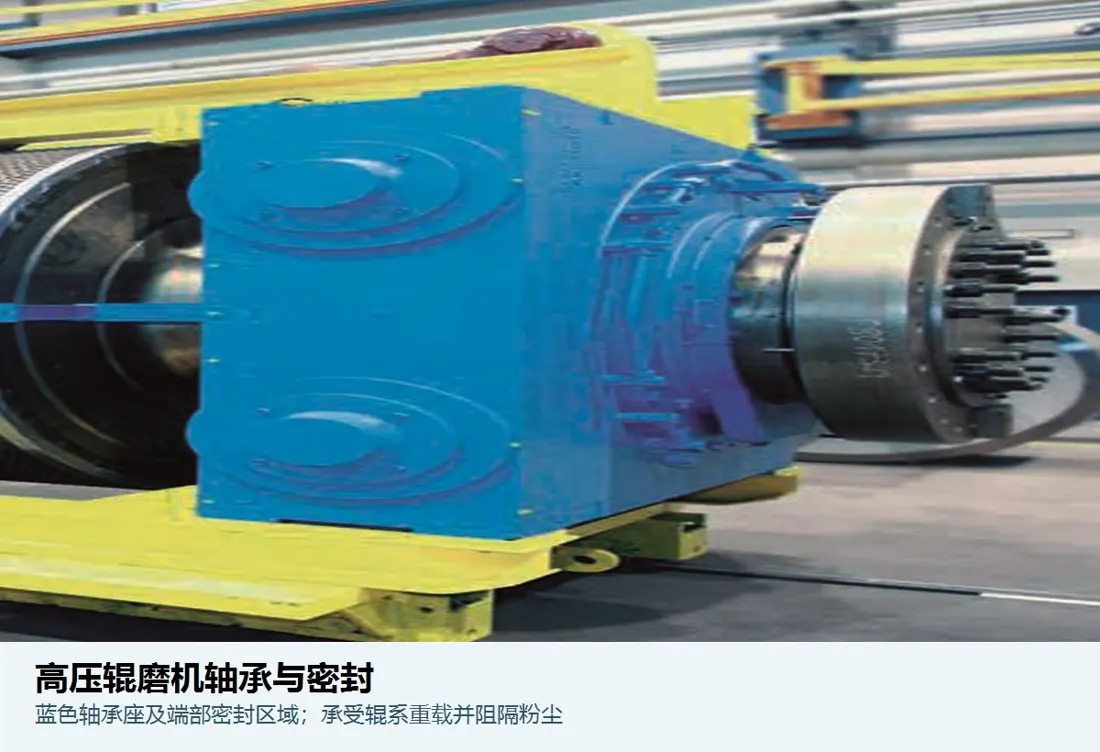
HPGR bearings carry roll-press loads and maintain rotational accuracy, while seals exclude dust and moisture and retain lubricant. ANRANST checks bearings, housings, journals, clearances, fits, lubrication and seals as one system. Matching bore and outside diameter cannot replace the full bearing designation and suffixes.
System function Bearing identification Full designation, suffixes, clearance, precision, cage and matched-set requirements Roll-end identification Fixed/floating roll, drive/non-drive end and orientation Fit identification Journal, housing bore, locking, location, preload or clearance Seal identification Profile, lip, labyrinth, material, orientation and fluid
Support rolls, transfer loads and maintain clean lubrication
Bearings carry radial loads and may also experience axial forces, impact and roll skew. Floating-roll positions must accommodate gap adjustment and housing movement.
Seal design, lubrication method, grease or oil, labyrinths and journal surfaces jointly determine contamination control. Seal damage can initiate bearing failure and requires assessment of the complete system.
Configuration and Performance
Use the full bearing designation and complete installation requirements together
Rolling elements, rings, cage, clearance, fits, lubrication and seals jointly determine reliability.
Fixed roll bearing positions
Check load direction, axial location, journal and housing fits, and the drive-end torque path.
Floating roll bearing positions
Check roll-gap adjustment, sliding or guided housing structures, and loads over the full operating stroke.
Drive and non-drive ends
End positions may require different locating arrangements, seals, attachments or axial restraints. Roll diameter alone does not establish interchangeability.
Clearance and internal configuration
Confirm clearance group, precision, rolling elements and cage against the original design and operating temperature. The basic designation alone is insufficient.
Lubrication and grease supply
Grease/oil, viscosity, replenishment quantity, passages, cleanliness and temperature directly affect friction, contamination and service life.
Multistage sealing systems
Check dust exclusion, labyrinths, main seals and contaminant-drainage or leakage paths together. Inspect journals and seal running surfaces.
Material and Manufacturing Requirements
Procure bearings and seals to complete specifications
Confirm internal materials, hardness and load requirements against the complete bearing specification, manufacturer data and OEM drawings.
Selection sequence: loads and environment → bearing internal loads, lubrication and contamination → complete configuration → fits and seals → procurement and inspection → installation records → temperature and vibration trends.
Failure Diagnosis
Use temperature, vibration, lubrication and inspection evidence to identify failure causes
Establish contamination, fit, lubrication and alignment problems before replacing bearings.
| Observed condition | Priority checks | Improvement Options |
|---|---|---|
| Continuously rising temperature | Lubricant quantity/viscosity, clearance, fits, preload, alignment, cooling and seal friction | Check installation and lubrication before increasing grease quantity |
| Increasing vibration or noise | Raceway damage, rolling elements, cage, contamination, looseness, uneven loading and roll operation | Combine spectrum analysis with teardown evidence to locate the cause |
| Raceway spalling or indentations | Loads, contamination, installation impact, fits, lubricant film and possible electrical erosion | Remove the root cause and improve installation cleanliness |
| Seal leakage or dust ingress | Lip/labyrinth, journal, orientation, eccentricity, temperature, fluid, venting and drainage | Inspect seals, running surfaces and lubrication together |
| Bearing creep and fretting at housing or journal fits | Fits, roundness, surfaces, locking, loads and previous repair dimensions | Restore controlled fits and address substrate damage before replacing the bearing |
Drawings and Inquiry Details
Identify spare parts by full designation, end position, fits and sealing system
Photograph nameplates and ring markings, and record all prefixes, suffixes, separators and associated parts.
Equipment and end position
OEM, full model, serial number, fixed/floating roll, drive/non-drive end and position number.
Full bearing designation
Manufacturer, basic designation, all suffixes, clearance, precision, cage, ring markings and quantity.
Installation and fits
Journal, housing bore, shoulders, locking parts, sleeves, spacers, fits, tolerances and assembly records.
Seal configuration
Main seals, labyrinths, O-rings, retaining rings, cross-sectional dimensions, materials, orientation and journal surfaces.
Drawing or sample and lubrication
drawing, customer model details, revision, lubricant, supply and cooling.
Operation and Failure
Load, speed, temperature, vibration, lubricant analysis, leakage, teardown photographs and time in service.
Related Equipment and Parts
Connect bearings with roll assemblies, OEM installations and seal materials
This page covers configuration and failure identification. Use OEM equipment pages to confirm the series, model, roll and end position.
General High Pressure Grinding Rolls Information Review fixed rolls, floating rolls, drives and hydraulic systems. HPGR Roll Surfaces and Sleeves Review the roll assemblies and working surfaces supported by the bearings. Metso HRC / HRCe Check HRC / HRCe models, roll assemblies and bearing positions. FLS HPGR Identify bearing designations and drawing through the FLS equipment series. thyssenkrupp Polysius HPGR Check roll support configurations through the brand's equipment series. Sealing Elastomers and Engineering Plastics Review seal material selection for fluid, temperature and speed.
ANRANST is an independent wear-parts engineering team. OEM and bearing brand names and trademarks belong to their respective owners. Before ordering, confirm the full model, designation, suffixes, drawing, dimensions, fits and operating conditions.