
Drawing and Engineering Review
We review mating surfaces and interface dimensions and assess material, heat treatment and manufacturing feasibility.
Transmits drive torque and carries rotor weight, impact reaction forces and cyclic bending and torsional loads.
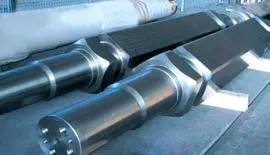
Rotor Main Shaft (Rotor Shaft)— Hammer Crusher Wear part, position 06.
| Material Options | Quenched and tempered alloy steel forgings such as 42CrMo/4140 or 34CrNiMo6, or forgings to ASTM A668 Class E as specified |
| Typical Properties and Acceptance Criteria | The mainshaft must withstand torsion, bending, impact and fatigue. Typical quenched and tempered hardness may be around 260–340 HB, subject to section size and OEM requirements. Key acceptance checks include steel cleanliness, forging reduction ratio, UT, journal roundness and surface finish, fillets, keyways or polygonal connections, straightness, runout and heat treatment uniformity. Plating or weld repairs without engineering review may introduce fatigue cracks. |
| Principal Failure Mechanism | Impact, cutting and abrasion |
Use these links for engineering pre-selection. Final fit must be checked against the full model, serial number, drawing revision, dimensions and actual duty.
Independent aftermarket information. OEM names and trademarks belong to their owners and do not imply authorization, affiliation or endorsement. Confirm the series, full model, serial number, drawings and duty before manufacture.
Provide the machine model, operating conditions and target service life so our engineers can recommend materials and prepare a quotation.
Or contact us directly: +86 156 3797 3199
zzx@anranst.com
ANRANST provides customers worldwide with engineering assessment, production at certified foundries to the customer technical requirements, quality control and finished-part delivery for custom wear parts and industrial spares, with scope to support other custom industrial parts.
We review mating surfaces and interface dimensions and assess material, heat treatment and manufacturing feasibility.
Material grades and heat-treatment processes are specified order by order, stated in the technical agreement and tracked through production.
Drawing confirmation, material and process control, production tracking, inspection and acceptance coordination.
We coordinate manufacturing, quality confirmation, packaging and delivery of complete finished parts in a workable, closed-loop supply process.
Provide the existing model, drawings, drawing, materials or operating conditions so we can identify the appropriate technical review and supply route.
Submit an Enquiry