
Primary Apron Liner
Receives the first stream of large material thrown by the blow bars and breaks it by high-impact rebound.
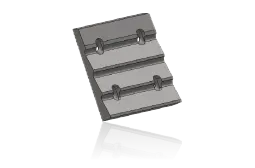
Primary Apron Liner (First Apron Liner)— Impact Crusher Wear part, position 09.
Emplacement et fonction
| Material Options | High-manganese steel, martensitic wear-resistant steel or a composite with a tough matrix |
| Typical Properties and Acceptance Criteria | The first apron liner receives the largest lumps and highest impacts, so fracture resistance and core toughness are priorities. High-manganese steel needs sufficient impact to work-harden. Martensitic steel commonly lies around 45–55 HRC, with hardness gradients and residual stresses controlled in thick sections. Ceramic/MMC options require defined limits on tramp material and maximum feed size. |
| Principal Failure Mechanism | Sliding or three-body abrasion, localized impact and cracking around fastener holes |
Informations de commande / RFQ
- Equipment manufacturer, machine model, serial number, model details and latest drawing revision;
- Part dimensions, unit weight, key tolerances, assembly and fastening method;
- Current material, chemical composition, heat treatment, hardness and mechanical property reports;
- Processed material, maximum particle size, hardness/abrasiveness, moisture and tramp material records;
- Speed, load, temperature, pressure, process medium chemistry and continuous operating time;
- Failure photographs, wear measurements, crack/fracture locations and current service life;
Materials and values are for preliminary engineering selection. Final chemical composition, heat treatment, hardness and dimensional tolerances must follow the OEM drawings and technical agreement.
Pages associées
Équipements, matériaux et installations OEM
Utilisez ces liens pour une présélection technique. L'adaptation finale doit être confirmée avec le modèle complet, le numéro de série, la révision du plan, les dimensions et les conditions réelles.
Équipement associé
Installation OEM
Matériaux associés
Informations indépendantes du marché de rechange. Les noms et marques OEM appartiennent à leurs titulaires et n'impliquent ni autorisation, ni affiliation, ni endorsement. Confirmez la série, le modèle complet, le numéro de série, les plans et les conditions avant fabrication.